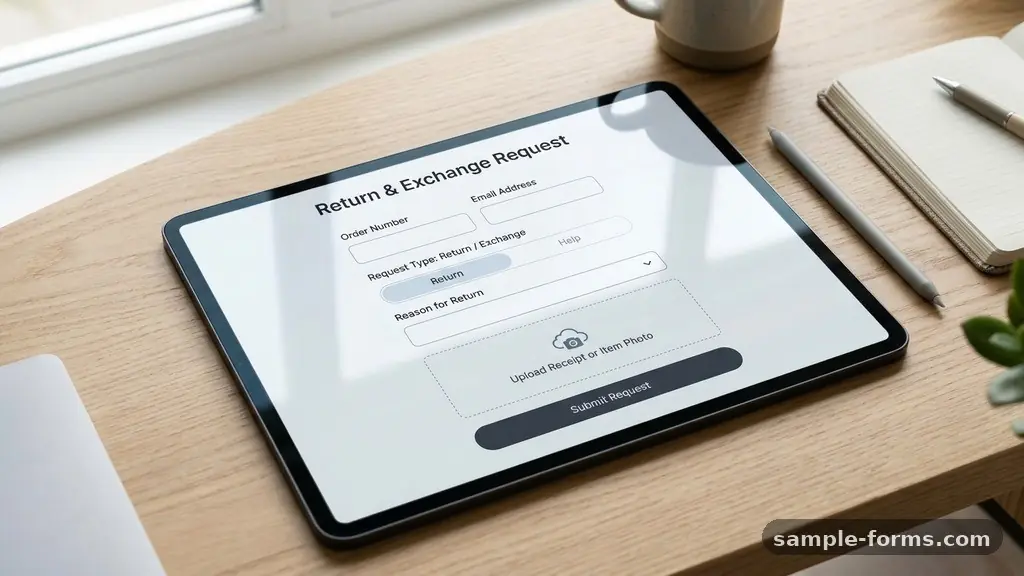
A well-designed return and exchange request form acts as the bridge between a disappointed customer and a satisfied brand loyalist. By streamlining the way shoppers submit their inquiries, you minimize friction in your reverse logistics process while gathering the data necessary to resolve issues quickly.
Whether you are managing a small boutique or a high-volume warehouse, the structure of your form directly influences how efficiently your team can process returns and manage inventory. This guide explores the essential components that make these documents effective for both the consumer and the back-end support staff, ensuring that every submission provides clear, actionable information for your operations team.
The core components of an effective submission page
At its simplest, an effective return and exchange request form must capture four primary pieces of information to function correctly. You need the customer’s full name, their original order number, the specific SKU tracking information for the items involved, and the reason for the return. Without these four elements, your customer service team will spend valuable time playing “email tag” to verify details.
By requiring these fields upfront, you enable your staff to cross-reference the sale in your database immediately. This initial accuracy sets the tone for the entire resolution process, turning a potentially frustrating situation into a professional interaction.
Integrating automated workflows for faster processing
Modern ecommerce customer experience relies heavily on speed and transparency. When you connect your form to an automated workflow, you can trigger instant email confirmations that reassure the customer their request is being handled. These systems can automatically validate the order number against your historical sales data, preventing invalid requests from entering your queue.
If the order is eligible for a return based on your established return policy terms, the system can even generate a shipping label generation prompt immediately. This removes the manual burden from your staff, allowing them to focus on complex cases rather than simple data entry.
Understanding the role of the return merchandise authorization
The return merchandise authorization, or RMA number, is the key to maintaining sanity in a warehouse environment. When a customer includes this unique identifier on their package, your receiving team knows exactly which order the items belong to without having to guess or hunt through paper records.
You should prominently display this number requirement on your form and include instructions on how to print or write it on the return shipping label. This small requirement creates a massive ripple effect in operational efficiency, as it drastically reduces the time spent on product condition assessment upon arrival.
Designing for clarity and user-friendliness
Your form layout should be clean, intuitive, and mobile-responsive, as many users will attempt to initiate returns from their smartphones. Avoid cluttered designs that force users to scroll unnecessarily or hunt for hidden fields. Use clear labels for every input box, and provide helpful tooltips if a specific field—like identifying a product SKU—might be confusing to a layperson.
A logical flow, such as grouping personal information, order details, and item-specific issues in distinct sections, helps the user complete the process without feeling overwhelmed. Keep the design minimal to reduce the cognitive load on a customer who is already likely feeling frustrated.
Managing expectations with clear policy integration
Transparency regarding your financial terms is vital to maintaining customer trust throughout the return journey. If you charge a restocking fee for certain items, disclose this clearly on the form before the user hits the submit button. You should also outline expected refund processing time so that users aren’t left wondering when their money will return to their account.
By linking to your full policy, you provide a safety net for customers who have questions about specific product categories or conditions. Providing this information upfront prevents disputes and helps the customer understand the boundaries of your return program.
Handling partial refunds and exchange preferences
Many returns aren’t simple “refund or keep” scenarios, especially when dealing with multi-item orders. Your layout needs to accommodate partial refund requests, allowing customers to select exactly which items from an order they wish to return. Include a dropdown menu or checklist that lets the user specify if they prefer a store credit, a direct refund to the original payment method, or an exchange for a different size or color.
This level of granularity prevents confusion in your warehouse, as the team will know exactly what the customer expects to receive in return. Clarifying these preferences early saves your support staff from having to manually reconcile inventory or payment adjustments later.
Optimizing for the customer support portal
Integrating your form into a dedicated customer support portal creates a centralized hub for all post-purchase interactions. When a customer logs into their account to initiate a return, the system can pre-fill their address and purchase history, which significantly reduces the time they spend typing. This integration also allows the customer to track the status of their return in real time, moving from “request submitted” to “received” and finally “refund processed.”
Providing this visibility reduces the volume of “Where is my refund?” tickets your team receives. It transforms the return process from a black box into a transparent, managed service.
The importance of proof of purchase and documentation
Requiring a proof of purchase, such as a receipt image or an order confirmation screenshot, is essential for preventing fraud. While most customers are honest, having a formal field to upload supporting documentation can be very helpful for high-value items. This allows your team to verify the condition of the item via photos if the customer is claiming the product arrived damaged or defective.
You can review official guidance on consumer trade regulations to ensure your documentation requirements remain compliant with local laws. Balancing security with ease of use ensures your business stays protected while maintaining a helpful, approachable image.
Comparison of return flow efficiency
The table below illustrates how different levels of automation affect the time and resources required to process a single return request.
| Process Type | Manual Time per Return | Automated Workflow | Staff Intervention Required |
|---|---|---|---|
| Email-only requests | 15-20 minutes | None | High |
| Basic Web Form | 8-10 minutes | Partial | Medium |
| Portal with RMA Integration | 2-3 minutes | Full | Low |
Essential checklist for your form launch
Before you go live with your new submission layout, ensure you have covered every functional base. A well-prepared form serves as the foundation for a positive customer experience, regardless of whether the transaction was successful or not.
- Confirm that the order number field validates against your existing database.
- Ensure that the return reason dropdown includes common options like “Defective,” “Wrong Size,” or “Changed Mind.”
- Verify that the form is mobile-friendly and displays correctly on all common screen sizes.
- Test the automated email confirmation sequence to ensure the customer receives a tracking number or RMA reference.
- Check that the restock fee or shipping fee disclosures are visible and easy to read.
- Make sure the “Submit” button is clearly visible and provides feedback once clicked.
Frequently Asked Questions
How can I reduce the number of returns I receive?
Providing highly accurate product descriptions, size charts, and high-resolution images is the most effective way to manage customer expectations. When customers have a clear understanding of what they are purchasing, they are significantly less likely to initiate a return due to unmet expectations or sizing issues.
Should I require a photo for every return request?
Requiring photos for every return can create unnecessary friction and may frustrate your customers. Instead, use conditional logic in your form: only require photo uploads if the customer selects “Damaged” or “Defective” as their reason for the return.
What is the best way to handle return shipping costs?
The approach to shipping costs depends on your brand strategy and margins. Some companies offer free returns as a competitive advantage to encourage higher conversion rates, while others pass the shipping cost to the customer to protect their bottom line. Be transparent about your policy on the form so the customer knows if they are responsible for the label cost.
How do I handle returns for items that were purchased on sale?
Clearly state your policy regarding clearance or sale items in your terms and conditions. If these items are non-returnable, ensure this is highlighted at the checkout stage and reiterate it on your return portal. This prevents confusion and reduces the volume of support requests for items that cannot be refunded.
How long should I keep return data on file?
You should keep records of returns for at least as long as your tax and accounting obligations require, typically several years. Keeping this data helps you identify patterns in product defects or shipping issues, which can provide valuable insights for future inventory planning.
Conclusion
Creating a professional and efficient process for handling customer returns is a hallmark of a mature, customer-centric business. By focusing on a clear, data-driven structure for your return and exchange request form, you provide your team with the tools they need to resolve issues quickly while maintaining a positive relationship with your shoppers. Remember that every return is an opportunity to learn about your products and improve your service, so treat these submissions as valuable feedback rather than just operational burdens.
With the right systems in place, you will find that a smooth return experience often leads to increased long-term loyalty and repeat purchases. Feel free to refine your layout as your business grows and your specific needs evolve.