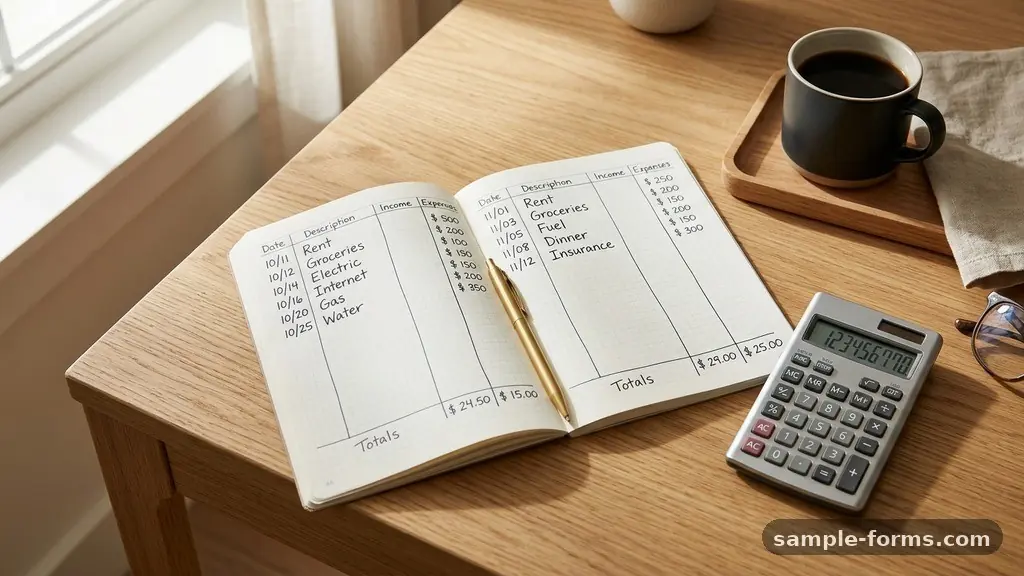
Learning the art of creating a Household Expense Record Form allows you to gain total clarity over your financial life. When you track every dollar, you stop wondering where your paycheck went and start directing your money toward what matters most.
Whether you prefer a digital spreadsheet or a physical ledger, the act of recording your spending shifts your mindset from passive consumption to active management. This article provides the framework you need to build a system that works, helping you master your monthly cash flow and achieve your long-term financial goals with confidence and ease.
The Core Purpose of Expense Tracking
The primary reason for building an expense tracker is to reveal the truth about your spending habits. Most households believe they spend a certain amount on groceries or entertainment, but reality often tells a different story.
By logging every transaction, you eliminate the guesswork and face the actual numbers. This transparency is the first step toward effective personal finance management.
Once you see where your money goes, you can identify leaks in your budget. You might discover that a recurring subscription you haven’t used in months is quietly draining your bank account.
Or, you may find that small, daily purchases add up to a significant portion of your net income. When you have a clear category breakdown, you can make informed decisions about where to cut back.
Tracking also helps you align your spending with your core values. If you want to save for a home or pay off debt, your record form acts as a compass.
It tells you immediately if you are on track or if you need to adjust your behavior before the month ends. This proactive approach prevents financial stress and builds a sense of security.
Essential Data Columns for Your Form
When you sit down for the process of creating a Household Expense Record Form, you need to choose the right columns. Keep it simple enough to maintain, but detailed enough to be useful for analysis later.
If the form is too complex, you will eventually stop using it. Stick to a structure that captures the basic “who, what, when, and how much.”
You should include a date column to track when the money left your account. A description column is necessary to identify the merchant or the purpose of the payment.
You also need a category column to group expenses like housing, food, transportation, and utilities. Finally, include an amount column and a payment method column to distinguish between cash, credit cards, or bank transfers.
Recommended Column Structure
- Date: The exact day the transaction occurred.
- Merchant/Description: Who you paid and for what service.
- Category: A tag like “Groceries,” “Rent,” or “Entertainment.”
- Amount: The precise dollar value of the transaction.
- Payment Method: Whether you used a debit card, credit card, or cash.
- Status: A checkbox to confirm the payment has cleared or been reconciled.
Choosing Your Tool: Spreadsheets vs. Paper
Selecting the right medium is critical for consistency. If you love technology, spreadsheet software is the most powerful choice.
Microsoft Excel or Google Sheets offer built-in formulas that can automatically sum your totals and create visual charts. These tools are excellent for people who want deep insights into their spending habits over time.
For those who prefer a tactile experience, a physical notebook or a printed ledger works just as well. Some people find that writing down expenses by hand makes them more mindful of their spending.
It forces you to slow down and acknowledge each transaction. You can always transfer your handwritten notes to a digital summary at the end of the month if you need a long-term record.
Regardless of the tool, the best system is the one you actually use. If you struggle with consistency, start with a simple physical form on your refrigerator.
If you are tech-savvy, set up a shared document that you and your partner can access from your phones. The goal is to make the act of recording as frictionless as possible.
Categorizing Fixed vs. Variable Costs
Understanding the difference between fixed and variable costs is vital for financial health. Fixed costs are the recurring bills that remain the same each month, such as rent, mortgage payments, or insurance premiums.
These are your baseline expenses that you must pay to maintain your lifestyle. Because they are predictable, they are the easiest to plan for in your budget template.
Variable costs, on the other hand, change based on your behavior and needs. This group includes items like groceries, dining out, clothing, and hobby expenses.
These are the areas where you have the most control and the greatest opportunity to save money. By separating these in your record form, you can see exactly how much “wiggle room” you have in your budget.
Expense Category Comparison
| Expense Type | Frequency | Predictability | Control Level |
|---|---|---|---|
| Rent/Mortgage | Monthly | High | Low |
| Utilities | Monthly | Moderate | Moderate |
| Groceries | Weekly | Low | High |
| Entertainment | Ad-hoc | Very Low | Very High |
Managing Recurring Bills and Subscriptions
Recurring bills are often the most overlooked part of a household budget. Because they are often automated, they can slip your mind until your bank balance drops lower than expected.
Your record form should have a dedicated section or a separate tab to track these regular obligations. This prevents you from being caught off guard by annual fees or price increases.
List every subscription service, insurance payment, and utility bill that hits your account on a regular schedule. Note the due date and the expected amount for each.
If a bill fluctuates, like an electric bill, use an average amount to estimate your monthly cash flow. This creates a safety net, ensuring you always have enough set aside for your core obligations.
Review this list every quarter to see if any services are still providing value. Many households pay for streaming services or gym memberships they no longer use.
By keeping these in a visible list, you empower yourself to cut unnecessary costs. This simple audit can save you hundreds of dollars annually, which you can then divert toward your savings rate or debt repayment.
The Power of Regular Reconciliation
Creating a Household Expense Record Form is useless if you never look at the results. You must set aside time—perhaps 15 minutes every Sunday—to reconcile your records with your actual bank statements.
This process ensures that no transactions were missed and that your math is accurate. It also provides a moment of reflection on your spending during the past week.
Reconciliation is not about judging your past mistakes. It is about gathering data so you can make better choices in the future. When you see that you exceeded your dining-out budget, look at the reasons why.
Maybe you were too tired to cook, or perhaps you had an unplanned social event. Understanding the “why” behind the numbers is the key to changing your habits.
Use this time to update your projections for the remainder of the month. If you see that you have spent more than half of your grocery budget in the first week, you can adjust your meal plan accordingly.
This is the definition of active money management. You are no longer reacting to your bank balance; you are steering it.
Setting Realistic Financial Goals
Once you have a few months of data, you can start setting concrete financial goals. Use your average spending as a benchmark to determine how much you can realistically save each month.
Perhaps you want to build an emergency fund of $5,000 or pay off a specific credit card. Having a record of your expenses makes these goals feel attainable and measurable.
Your savings rate should be a priority, not an afterthought. When you create your budget, treat your savings contribution as a fixed expense that gets paid first.
If your record form shows that your expenses consistently match your income, you need to find areas to trim. Look for small, non-essential purchases that you can eliminate to create space for your savings.
For more guidance on managing your money effectively, you can visit resources like the Consumer Financial Protection Bureau, which offers helpful tools for household planning. Remember that financial goals are not static.
As your income changes or your life circumstances shift, your budget should evolve to match. Regularly updating your plan ensures that your money continues to serve your long-term vision.
Common Pitfalls to Avoid
Many people fail at budgeting because they try to be too perfect. They create complex, multi-tab spreadsheets that require hours of data entry each week.
Soon, the chore becomes overwhelming, and they abandon the system entirely. Avoid this by keeping your form as simple as possible while still capturing the necessary information.
Another common mistake is forgetting to track small cash purchases. A coffee here and a snack there might seem insignificant, but they add up to substantial amounts over a month.
If you use cash, make it a habit to collect your receipts or log the purchase on your phone immediately. If you don’t account for these, your totals will never match your bank balance.
Finally, do not let an occasional overspend discourage you. Everyone has months where unexpected costs arise or discipline slips. The value of your record form is not in being perfect, but in being aware.
If you miss a week of tracking, just pick it up again the following Monday. Consistency over the long term is far more important than daily perfection.
Frequently Asked Questions
How often should I update my expense record?
You should aim to update your record at least once a week. This keeps the task manageable and ensures you don’t forget smaller transactions. Some people prefer to log expenses daily to keep their balance top-of-mind, but weekly is usually sufficient for most households.
Should I include business expenses if I am self-employed?
It is best to keep business and personal expenses completely separate. Use a different form or account for business transactions to simplify your tax filing. Mixing them makes it very difficult to see your true personal financial health and can complicate your bookkeeping.
What if my partner doesn’t want to track expenses?
Open a conversation about your shared financial goals rather than focusing on the “chore” of tracking. Explain that the data helps you reach your dreams, like buying a house or traveling, together. Start by having them track just one category of spending to show how easy and revealing it can be.
How do I handle expenses that are paid annually?
Divide the annual cost by 12 and treat that amount as a monthly “sinking fund” contribution. Set this money aside in a separate savings account so that when the annual bill arrives, you have the full amount ready. This prevents the shock of a large, one-time payment.
Is it better to track net or gross income?
Always track your net income, which is the amount that actually hits your bank account after taxes and deductions. Your budget must be based on the money you have available to spend. Using gross income will lead to an unrealistic budget and potential financial trouble.
Final Thoughts
Creating a Household Expense Record Form is one of the most effective ways to take control of your future. By documenting your spending, you move from wondering where your money went to telling it where to go. This shift in perspective is the foundation of long-term financial health and peace of mind.
Start simple, remain consistent with your entries, and adjust your plan as your life changes. As you become more familiar with your spending patterns, you will find that managing your money becomes less of a chore and more of a powerful tool for building the life you want. Take the first step today and watch how your financial clarity grows.