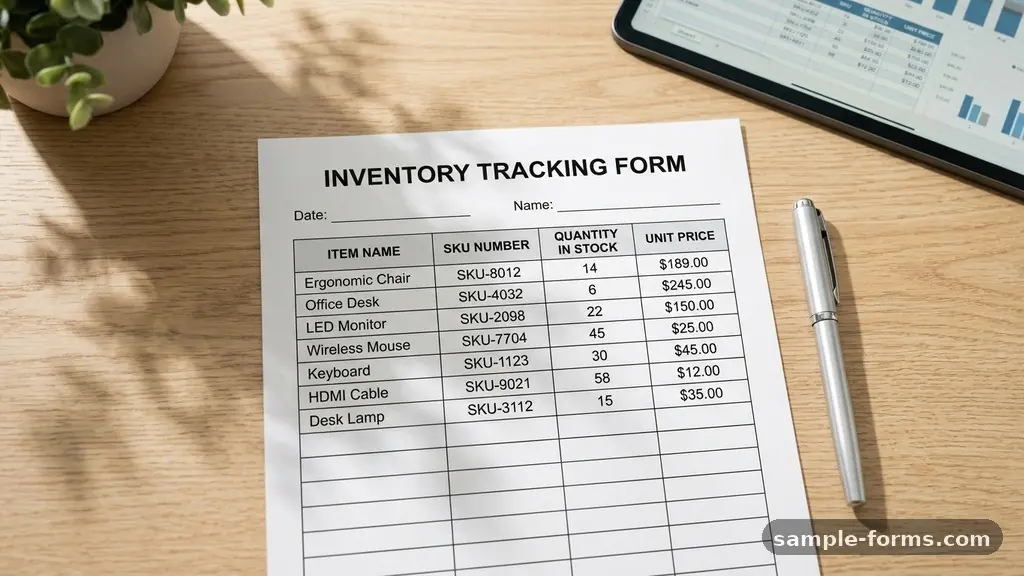
Implementing a simple Inventory Tracking Form provides the clarity needed to prevent stockouts and reduce excess capital tied up in unsold goods. By systematically recording essential data, businesses gain an accurate picture of their daily operations and long-term trends. This foundational approach to asset management saves time during audits and helps identify exactly when to replenish supplies.
Whether you are managing a small retail shop or a home-based craft business, mastering these basic records ensures your supply chain remains resilient. You will discover that consistent documentation is the most effective way to protect your margins and improve overall efficiency across your entire operation.
Core Data Points for Every Inventory Record
To build an effective system, you must first identify which data points are non-negotiable for daily operations. Every item in your warehouse or storage area requires a unique identifier, commonly referred to as a stock keeping unit or SKU.
This alphanumeric code acts as the primary key for your database, allowing you to track specific products without confusion. Alongside the SKU, you should record a clear, descriptive name and a category to help with sorting and reporting.
You must also document the current quantity on hand for every item to ensure your records reflect reality. This involves noting the initial count and updating it every time a new shipment arrives or a sale is finalized.
Recording the cost per unit is equally critical, as it allows for accurate stock valuation when calculating your total assets. If you do not track the unit cost, you will struggle to determine your profit margins or understand the true value of the items sitting on your shelves.
Finally, include the location of the item, especially if you store goods in multiple areas or bins. Knowing exactly where a product sits saves significant time during order fulfillment and cycle counting processes.
If you rely on physical spreadsheets, consider using spreadsheets templates to standardize how this data is captured. By keeping these five fields consistent—SKU, description, quantity, unit cost, and location—you create a reliable foundation for all future inventory analysis.
Understanding Reorder Points and Safety Stock
Knowing when to order more stock is perhaps the most difficult aspect of inventory management for growing businesses. A reorder point is the specific stock level at which you must trigger a new purchase order to avoid running out of product.
To calculate this, you need to account for your average daily usage and your supplier’s lead time. If you wait until your shelves are empty, you have already lost potential sales and frustrated your customers.
Safety stock acts as your insurance policy against unexpected spikes in demand or shipping delays from your vendors. It is the extra buffer of inventory you keep on hand to ensure you never hit zero during a stockout event.
Without this buffer, a simple two-day delay in delivery could bring your entire fulfillment process to a complete halt. You calculate safety stock by looking at your maximum daily usage and comparing it to your average usage to find the variance.
You should update your reorder points periodically as your business grows or as seasonal trends shift. What worked during the slow summer months will likely be insufficient during the busy holiday season.
By documenting these thresholds directly on your tracking forms, you remove the guesswork from the procurement process. This ensures that your team always knows exactly when to initiate a reorder, maintaining a steady flow of goods to your customers.
Methods for Tracking Stock Movements
Tracking inventory requires a consistent method for logging every movement of goods in and out of your facility. Cycle counting is a common practice where you count a small portion of your inventory on a rotating basis rather than performing one massive annual audit.
This approach helps identify discrepancies early, allowing you to address issues like inventory shrinkage before they become major financial losses. By counting just a few items each day, you maintain high accuracy without disrupting your daily workflow.
Many businesses start with manual logs, but the transition to a barcode scanner can significantly reduce human error. A scanner instantly updates your central database, ensuring that the stock level displayed on your screen matches what is physically on the shelf.
This level of automation is much faster than manual entry and provides real-time visibility into your current assets. If your volume is still low, a manual logbook or spreadsheet remains a perfectly valid, low-cost starting point.
Regardless of the technology you use, the process must be disciplined and standardized across your team. Every removal of stock for a sample, a return, or a damaged item must be documented immediately.
If these small movements go unrecorded, your data will become unreliable within weeks. Consistency is the primary factor that separates a successful inventory strategy from one that leads to constant confusion and financial waste.
Analyzing Inventory Turnover and Performance
Inventory turnover measures how many times your entire inventory is sold and replaced over a specific period. A high turnover rate generally indicates strong sales and efficient management, while a low rate suggests that you are holding onto items for too long.
By analyzing this metric, you can identify “dead stock” that is occupying valuable shelf space without generating revenue. This insight is essential for making informed decisions about which products to discontinue or discount.
Understanding your turnover helps you optimize your capital allocation. Money tied up in slow-moving inventory is money that cannot be used for marketing, new product development, or hiring.
You should calculate this metric quarterly to spot trends before they impact your overall cash flow. Comparing your performance year-over-year provides a clear picture of how your business is evolving and where you need to adjust your strategy.
Consider the following table when reviewing your stock performance metrics:
| Metric | Purpose | Ideal Outcome |
|---|---|---|
| Inventory Turnover | Measure sales velocity | High ratio |
| Lead Time | Track supplier reliability | Consistent, short duration |
| Shrinkage Rate | Monitor loss and theft | Near zero |
| Stockout Frequency | Assess replenishment timing | Zero incidents |
Managing Costs and Stock Valuation
Valuing your stock correctly is vital for your financial reporting and tax obligations. The FIFO method, or First-In, First-Out, is the most common approach for businesses that want to ensure their older stock is sold before newer arrivals.
This prevents items from expiring or becoming obsolete while sitting in the back of your warehouse. It also tends to align well with actual market prices for many types of consumer goods.
When you record your inventory costs, you must account for more than just the purchase price of the item. Include shipping costs, customs duties, and any other expenses incurred to get the product ready for sale.
These additional costs, often referred to as landed costs, provide a more accurate picture of your true profit margins. If you ignore these expenses, you might mistakenly believe a product is more profitable than it actually is.
Regularly reviewing your valuations allows you to assess the health of your business. If your costs are rising but you haven’t adjusted your selling prices, your margins will shrink silently.
Tracking these values requires a disciplined approach to documentation, but the reward is a clear understanding of your financial reality. Maintaining a simple Inventory Tracking Form that includes these cost fields will provide the data you need to make profitable pricing decisions.
Addressing Inventory Shrinkage and Accuracy
Inventory shrinkage refers to the loss of products due to theft, damage, administrative errors, or vendor fraud. It is an unfortunate reality for almost every business, but it can be managed through regular monitoring and security.
If your physical count never matches your recorded count, shrinkage is likely the culprit. You must investigate these discrepancies immediately to find the root cause, whether it is a faulty recording process or a security vulnerability.
Implementing simple security measures, such as limiting access to storage areas or using security cameras, can significantly reduce losses. You should also conduct periodic spot checks of high-value items to ensure they are still accounted for.
When you find a discrepancy, document it in your records as a “write-off” to keep your data accurate. Ignoring these small losses will eventually lead to significant tax and accounting issues during your year-end reconciliation.
Training your staff to handle inventory with care is another essential step in preventing damage. Many items are lost simply because they were stored improperly or handled roughly during transit.
By creating clear processes and holding team members accountable for their inventory tasks, you create a culture of accuracy. This diligence protects your bottom line and ensures your business runs smoothly every single day.
Integrating Systems for Efficiency
As your business scales, you may find that a simple spreadsheet is no longer sufficient for your needs. A warehouse management system can automate much of the manual work, integrating your inventory data with your sales and accounting platforms.
This integration ensures that when a customer makes a purchase, your inventory levels are updated instantly across all channels. It eliminates the need for manual data entry and reduces the risk of human error to near-zero.
Even with advanced software, the principles of a simple Inventory Tracking Form remain relevant. You still need to understand your reorder points, your lead times, and your stock valuation methods.
Software is merely a tool to execute these strategies more quickly and reliably. Do not make the mistake of assuming that technology can replace the need for sound inventory management practices.
Before investing in expensive software, ensure your manual processes are optimized and well-understood. If you cannot manage your inventory on a spreadsheet, you will likely struggle to manage it within a complex system as well.
Start by refining your data collection methods and ensuring that everyone on your team follows the same protocols. Once you have established a consistent routine, you will be in a much stronger position to transition to more powerful tools.
Frequently Asked Questions
What is the easiest way to start tracking inventory?
The easiest way to start is by using a spreadsheet to record the SKU, item description, current quantity, and cost for every product you have. Consistency is more important than the complexity of your system in the early stages.
How often should I perform a cycle count?
You should perform a cycle count as often as your business volume requires, but performing a small count of a few items every week is generally more effective than one annual audit. This keeps your data accurate without overwhelming your team.
What should I do if my inventory levels are always wrong?
If your levels are consistently off, you likely have a process gap in how you record incoming and outgoing stock. Start by reviewing your receiving and shipping procedures to ensure every movement is documented immediately.
How do I calculate my reorder point?
Your reorder point is calculated by multiplying your average daily usage by your lead time in days, then adding your safety stock. This gives you a specific number that tells you exactly when to place a new order.
Does every item need a unique SKU?
Yes, every distinct product variant, including different sizes or colors, requires its own unique SKU. This is the only way to ensure that your inventory data remains precise and actionable.
Refining Your Inventory Strategy
Developing a consistent routine for your documentation is the most reliable way to maintain accuracy and prevent costly errors. By using a simple Inventory Tracking Form, you ensure that your business has the right products available at the right time. This level of control reduces the stress of replenishment and gives you the confidence to grow your sales without worrying about hidden stock issues.
Take the time this week to review your current processes and identify one area that needs improvement. Whether it is standardizing your SKU naming convention or setting your first official safety stock levels, every small step contributes to a more stable operation.
If you commit to these basic management practices, you will see a direct impact on your efficiency and your bottom line. Feel free to start small, stay consistent, and reach out if you need further guidance on optimizing your workflow.